What do dipole dipole interactions try to maximize?
Dipole-Dipole Interactions
- Page ID
- 1658
Dipole-Dipole interactions result when two dipolar molecules interact with each other through space. When this occurs, the partially negative portion of ane of the polar molecules is attracted to the partially positive portion of the second polar molecule. This type of interaction between molecules accounts for many physically and biologically significant phenomena such equally the elevated boiling point of h2o.
Definition of a Dipole
Molecular dipoles occur due to the unequal sharing of electrons between atoms in a molecule. Those atoms that are more electronegative pull the bonded electrons closer to themselves. The buildup of electron density effectually an cantlet or discreet region of a molecule can outcome in a molecular dipole in which one side of the molecule possesses a partially negative charge and the other side a partially positive charge. Molecules with dipoles that are not canceled by their molecular geometry are said to be polar.
Case \(\PageIndex{one}\): Carbon Dioxide and Hydrogen Flouride
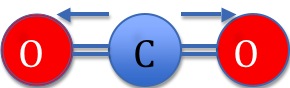
In Figure 1 above, the more than electronegative Oxygen atoms pull electron density towards themselves equally demonstrated past the arrows. Carbon Dioxide is not polar notwithstanding considering of its linear geometry. A molecule's overall dipole is directional, and is given by the vector sum of the dipoles betwixt the atoms. If we imagined the Carbon Dioxide molecule centered at 0 in the XY coordinate plane, the molecule's overall dipole would be given by the following equation:
\[\mu \cos(0) + -\mu \cos(0) = 0. \]
Where \(μ\) is the dipole moment of the bail (given past μ=Q x r where Q is the charge and r is the distance of separation). Therefore, the two dipoles cancel each other out to yield a molecule with no net dipole.
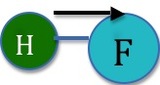
In contrast, figure 2 demonstrates a state of affairs where a molecular dipole does result. In that location is no opposing dipole moment to cancel out the one that is shown above. If we were to imagine the hydrogen flouride molecule placed so that the Hydrogen saturday at the origin in the XY coordinate plane, the dipole would be given past \(\mu \cos(0)=\mu\).
Potential Energy of Dipole Interaction
Potential energy is the maximum energy that is available for an object to do work. In physics, work is a quantity that describes the energy expended as a strength operates over a altitude. Potential energy is positional because it depends on the forces acting on an object at its position in space. For instance, nosotros could say that an object held above the ground has a potential energy equal to its mass 10 dispatch due to gravity x its peak above the ground (i.e., \(mgh\)). This potential free energy that an object has as a issue of its position can be used to practice work. For case we could utilize a pulley system with a large weight held above the ground to hoist a smaller weight into the air. Equally we drib the large weight information technology converts its potential energy to kinetic energy and does work on the rope which lifts the smaller weight into the air. It is important to remember that due to the second law of thermodynamics, the amount of work washed past an object can never exceed (and is often considerably less) than the objects potential energy.
On a subatomic level, charged atoms have an electric potential which allows them to interact with each other. Electric potential refers to the energy held by a charged particle as a effect of it's position relative to a second charged particle. Electric potential depends on accuse polarity, charge strength and distance. Molecules with the same accuse will repel each other every bit they come up closer together while molecules with opposite charges volition attract.
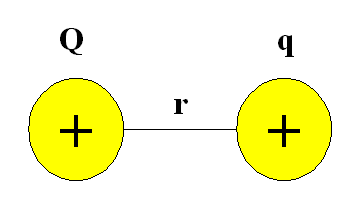
For two positively charged particles interacting at a distance r, the potential energy possessed by the system can be defined using Coulomb's Law:
\[5 = \dfrac{kQq}{r} \label{1}\]
where
- \(g\) is the Coulomb abiding and
- \(Q\) and \(q\) refer to the magnitude of the charge for each particle in Coulombs.
The above equation can too be used to calculate the distance between two charged particles (\(r\)) if nosotros know the potential energy of the system. While Coulomb's law is important, information technology only gives the potential free energy between two bespeak particles. Since molecules are much larger than bespeak particles and have accuse full-bodied over a larger area, we take to come up with a new equation.
The potential energy possessed past two polar atoms interacting with each other depends on the dipole moment, μ, of each molecule, the distance apart, r, and the orientation in which the two molecules interact. For the case in which the partially positive area of one molecule interacts only with the partially negative area of the other molecule, the potential free energy is given by:
\[V(r) = -\dfrac{2\mu_{1}\mu_{two}}{4\pi\epsilon_{o}r^{three}} \label{2}\]
where \(\epsilon_o\) is the permeability of space. If it is not the instance that the molecular dipoles interact in this directly terminate to cease manor, nosotros have to business relationship mathematically for the change in potential energy due to the angle between the dipoles. We can add an angular term to the above equation to business relationship for this new parameter of the system:
\[V (r) =-\dfrac{\mu_{1}\mu_{2}}{iv\pi\epsilon_{0}r_{12}^{3}}{(\cos\theta_{12}- 3\cos\theta_{ane}\cos\theta_{2})} \label{three}\]
In this formula \(\theta_{12}\) is the bending made by the ii oppositely charged dipoles, and \(r_{12}\) is the altitude between the two molecules. Also, \(\theta_{one}\) and \(\theta_{two}\) are the angles formed by the two dipoles with respect to the line connecting their centers.
It is also important to find the potential energy of the dipole moment for more than than 2 interacting molecules. An of import concept to go along in mind when dealing with multiple charged molecules interacting is that similar charges repel and reverse charges attract. And then for a organisation in which three charged molecules (2 positively charged molecules and 1 negatively charged molecule) are interacting, we need to consider the angle betwixt the attractive and repellant forces.
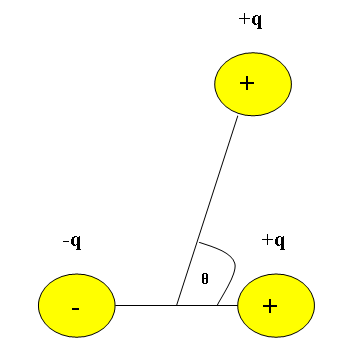
The potential energy for the dipole interaction between multiple charged molecules is:
\[V = \dfrac{kp \cos\theta}{r^{ii}} \label{iv}\]
where
- \(yard\) is the Coulomb constant, and
- \(r\) is the distance between the molecules.

Instance \(\PageIndex{2}\)
Calculate the potential energy of the dipole-dipole interaction betwixt 2 \(\ce{HF}\) molecules oriented along the x axis in an XY coordinate aeroplane whose area of positive charge is separated past 5.00 Angstroms from the area of negative charge of the adjacent molecule:
Solution
The Dipole moment of the HF molecules can be found in many tables, μ=1.92 D. Assume the molecules exist in a vacuum such that \(\epsilon_{0}=8.8541878\times10^{-12}C^2N^{-ane}m^{-2}\)
\[\mu=i.92D\times3.3356\times10^{-xxx}\dfrac{Cm}{D}=6.4044\times10^{-thirty}Cm\]
At present use Equation \ref{2} to calculate the interaction energy
\[\begin{marshal*}V&=-\dfrac{2(6.4044\times10^{-xxx}Cm)^2}{4(eight.8541878\times10^{-12}C^2N^{-1}m^{-2})(5.0\times10^{-10})^3} \\[4pt] &=1.4745\times10^{-19}Nm \finish{align*}\]
Example \(\PageIndex{iii}\)
Now imagine the same two HF molecules in the post-obit orientation:
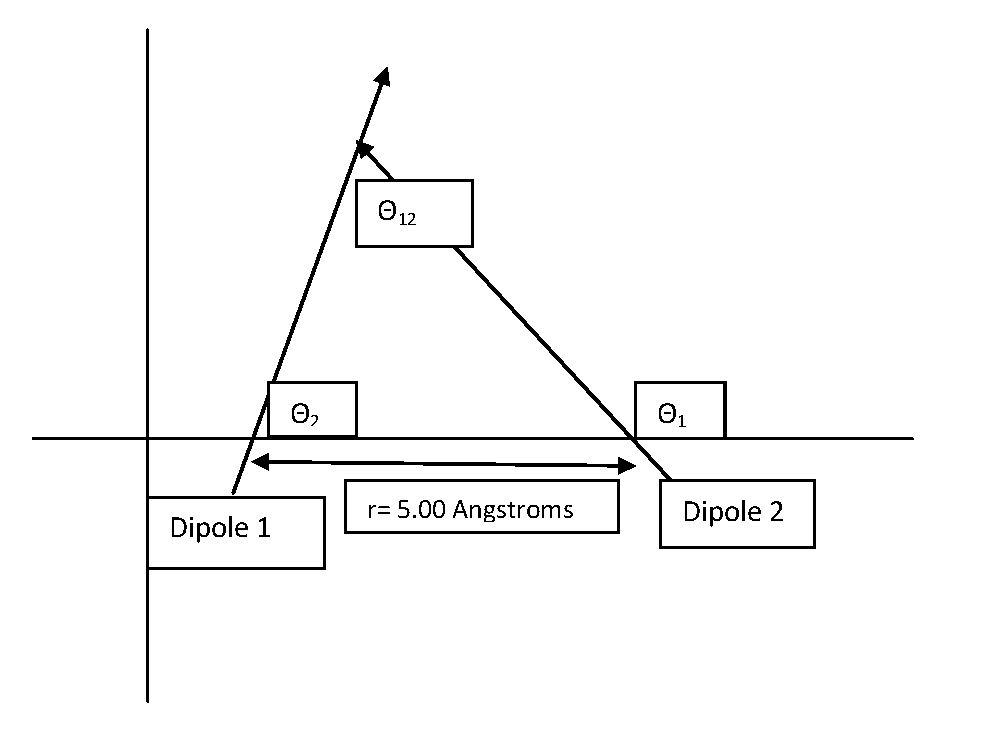
Given: \(\theta_{1}=\dfrac{iii\pi}{4}\), \(\theta_{two}=\dfrac{\pi}{3}\) and \(\theta_{12}=\dfrac{5\pi}{12}\)
Solution
\[\brainstorm{align*} V&=-\dfrac{(six.4044\times10^{-xxx}Cm)^2}{4\pi(8.8541878\times10^{-12}C^2N^{-one}m^{-2}(5.00\times10^{-ten}m)^three}(\cos\dfrac{5\pi}{12}-iii\cos\dfrac{3\pi}{4}\cos\dfrac{\pi}{three}) \\[4pt] &=-9.73\times10^{-20}Nm=9.73\times10^{-20}J\end{align*}\]
Dipole-Dipole Interactions in Macroscopic Systems
Information technology would seem, based on the in a higher place discussion, that in a arrangement equanimous of a large number of dipolar molecules randomly interacting with 1 another, V should go to cipher because the molecules adopt all possible orientations. Thus the negative potential energy of two molecular dipoles participating in a favorable interaction would be cancelled out by the positive energy of two molecular dipoles participating in a high potential energy interaction. Opposite to our assumption, in bulk systems, it is more than probable for dipolar molecules to interact in such a way every bit to minimize their potential free energy (i.due east., dipoles form less energetic, more probable configurations in accordance with the Boltzmann'southward Distribution). For example, the partially positive expanse of a molecular dipole existence held next to the partially positive expanse of a second molecular dipole is a high potential energy configuration and few molecules in the organisation volition have sufficient energy to adopt it at room temperature. Generally, the higher potential energy configurations are only able to be populated at elevated temperatures. Therefore, the interactions of dipoles in a majority Solution are not random, and instead adopt more likely, lower free energy configurations. The following equation takes this into account:
\[Five=-\dfrac{2\mu_{A}^2\mu_{B}^ii}{three(four\pi\epsilon_{0})^2r^6}\dfrac{one}{k_{B}T} \label{five}\]
Instance \(\PageIndex{4}\)
Looking at Equation \ref{5}, what happens to the potential energy of the interaction as temperature increases.
Solution
The potential energy of the dipole-dipole interaction decreases as T increases. This can be seen from the form of the above equation, but an caption for this ascertainment is relatively simple to come by. Every bit the temperature of the system increases, more molecules accept sufficient energy to occupy the less favorable configurations. The higher, less favorable, configurations are those that requite less favorable interactions betwixt the dipoles (i.e., higher potential energy configurations).
Instance \(\PageIndex{v}\)
Summate the average energy of HF molecules interacting with 1 some other in a bulk Solution assuming that the molecules are 4.00 Angstroms autonomously in room temperature Solution.
Solution
Using Equation \ref{five} to calculate the bulk potential free energy:
\[\begin{align*} 5&=-\dfrac{2}{3}\dfrac{(6.4044\times10^{-30}Cm)^4}{(iv\pi(eight.8541878\times10^{-12}C^2N^{-1}grand^{-2})^2(4.00\times10^{-ten}yard)^6}\dfrac{one}{(1.381\times10^{-23}Jk^{-1})(298k)} \\[4pt] &=-five.46\times10^{-21}J\finish{align*}\]
Example \(\PageIndex{half dozen}\)
What is the amount of energy stabilization that is provided to the system when 1 mole of HF atoms interact through dipole-dipole interactions.
Solution
Since we have already calculated above the average potential free energy of the HF dipole-dipole interaction this problem can exist hands solved.
\[\brainstorm{marshal*} Five &=-5.46\times10^{-21}J\times(6.022\times10^{23}mol^{-1}) \\[4pt] &=-3288\dfrac{J}{mol}=three.29\dfrac{kJ}{mol} \cease{align*}\]
Biological Importance of Dipole Interactions
The potential energy from dipole interactions is important for living organisms. The biggest touch on dipole interactions have on living organisms is seen with poly peptide folding. Every process of protein formation, from the binding of private amino acids to secondary structures to tertiary structures and fifty-fifty the germination of quaternary structures is dependent on dipole-dipole interactions.
A prime example of quaternary dipole interaction that is vital to human health is the germination of erythrocytes. Erythrocytes, commonly known as red blood cells are the prison cell type responsible for the gas exchange (i.e. respiration). Inside the erythrocytes, the molecule involved in this crucial procedure, is 'hemoglobin', formed by four protein subunits and a heme group'. For an heme to form properly, multiple steps must occur, all of which involve dipole interactions. The four protein subunits—2 alpha chains, two beta bondage—and the heme grouping, interact with each other through a series of dipole-dipole interactions which let the erythrocyte to take its concluding shape. Whatever mutation that destroys these dipole-dipole interactions prevents the erythrocyte from forming properly, and impairs their ability to comport oxygen to the tissues of the body. So we can see that without the dipole-dipole interactions, proteins would not be able to fold properly and all life as we know it would stop to be.
References
- Le Fèvre, R. J. W. (1953). Dipole moments; their measurement and application in chemistry. London, Methuen.
- Atkins, P. W. and J. De Paula (2006). Physical chemistry for the life sciences. New York, Oxford Academy Press ; Freeman.
- Petrucci, R. H., W. S. Harwood, et al. (2002). General chemical science : principles and modern applications. Upper Saddle River, Northward.J., Prentice Hall.
- Bloomfield, Chiliad. M. (1992). Chemistry and the living organism. New York, Wiley.
- Silbey, R. J., R. A. Alberty, et al. (2005). Concrete chemical science. Hoboken, NJ, Wiley.
- HyperPhysics. http://hyperphysics.phy-astr.gsu.edu/hbase/hframe.html Georgia State University, Department of Physics and Astronomy. 2008.
- Campbell, N. A. and J. B. Reece (2005). Biological science. San Francisco, Pearson Benjamin Cummings.
- Chang, Raymond. (2005). Physical Chemistry for the Biosciences. Sausalito, California, University Scientific discipline Books.
Contributors and Attributions
- David Johns (UCD), Joel Approximate (UCD)
-
Gary L Bertrand, Professor of Chemistry, Academy of Missouri-Rolla
minterripplexprem.blogspot.com
Source: https://chem.libretexts.org/Bookshelves/Physical_and_Theoretical_Chemistry_Textbook_Maps/Supplemental_Modules_(Physical_and_Theoretical_Chemistry)/Physical_Properties_of_Matter/Atomic_and_Molecular_Properties/Intermolecular_Forces/Specific_Interactions/Dipole-Dipole_Interactions

Post a Comment for "What do dipole dipole interactions try to maximize?"